
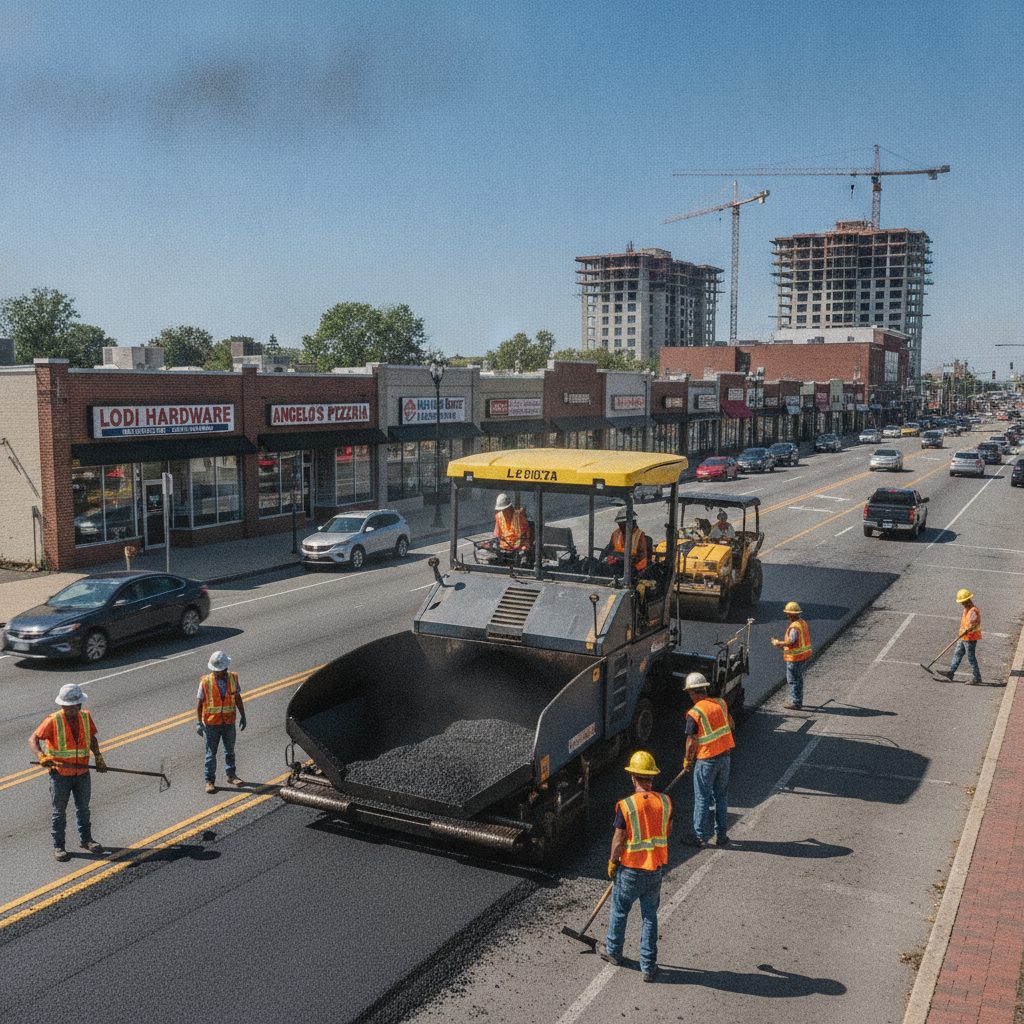
Every business owner asks the same question before a paving project begins: how long will this actually take, and what will it cost me in lost customers? For anyone planning commercial asphalt paving Lodi NJ businesses can rely on, the honest answer is that the timeline depends on far more than the day the crew shows up. Some lots are milled, graded, paved, and striped within a few days. Others stretch across weeks because of drainage work, permitting, weather, or the need to keep part of the property open for tenants and deliveries.
Understanding the stages of a paving job helps you plan around them instead of being surprised by them. Owners who know what happens before, during, and after the crew arrives can schedule deliveries, notify tenants, and protect revenue. This guide walks through the full timeline from first walkthrough to final striping. We cover what drives a project longer, how phasing keeps a business open, what curing really means, and how to build a schedule that fits a working property. Whether you manage a single storefront, a warehouse yard, or a multi-tenant plaza, you will leave with a realistic picture of what to expect and a clear list of questions to ask your contractor before signing anything.
Why Paving Timelines Vary So Much From Site to Site
No two commercial lots are the same, which is why a quoted timeline from a neighbor’s project rarely applies to yours. A small, flat lot with solid subgrade might need a single day of paving after prep. A large lot with failed areas, poor drainage, and utility covers to adjust can take a week or more. Square footage matters, but condition matters more. Crews need to know what lies beneath the surface before they can commit to a schedule.
Other variables include access, tenant activity, and the type of work chosen. A full-depth reconstruction takes longer than a mill and overlay, and both take longer than a simple resurfacing. If you are weighing options, a quick look at professional asphalt paving services can help you understand which approach fits your property and how that choice shapes the calendar. The goal is to match the scope to the actual condition of the pavement, not to guess.
The Site Walkthrough and Estimate Stage
Your timeline starts well before any equipment arrives. The first stage is an on-site walkthrough where a estimator measures the lot, notes cracking patterns, checks for standing water, and asks how the property operates day to day. Expect this to take under an hour for most sites, with a written proposal following within a few days.
This is the moment to be specific about your business. Tell the estimator when deliveries arrive, when peak customer traffic occurs, and which entrances are critical. A good proposal will include scope, materials, expected duration, and a plan for traffic control. If a contractor cannot describe how long each phase will take, treat that as a warning sign. Vague schedules usually become long schedules.
Plan on a couple of weeks between the first call and a signed agreement if you are comparing multiple bids. Rushing this step often leads to scope changes later, and scope changes are the most common reason projects run past their original dates.
Permits, Utilities, and Pre-Construction Coordination
Depending on the scope, some projects need municipal review or approval before work can begin, particularly when grading, drainage, or the number of parking spaces changes. Simple resurfacing often moves faster than a redesign, so confirm early whether your project triggers any local requirements. Your contractor should tell you what applies, and you should never assume that approvals will happen instantly.
Utility coordination also adds lead time. Manholes, valve covers, and drains need to be located and adjusted to the new surface height, and any marked underground lines must be respected during excavation. If drainage is part of the problem, it pays to read up on How Drainage Design Protects Commercial Asphalt Lots in Lodi, NJ before finalizing the scope, since fixing grade issues during paving is far cheaper than redoing a lot that ponds water after the first storm.
Budget a buffer for this phase. Paperwork and coordination rarely show up on a crew’s work schedule, yet they quietly decide when the first truck can roll.
Demolition, Milling, and Base Repair Days
Once the crew mobilizes, the first physical work is removing what no longer performs. Milling machines grind off the worn surface layer, while excavators and loaders strip failed sections down to the base. Milling a typical lot can often be done in a day, but full removal and rebuilding takes longer, especially if soft spots need to be dug out and replaced with stone.
Base repair is where hidden problems appear. Sections that looked fine from above may have wet, pumping subgrade that must be corrected before new asphalt goes down. Ignoring this step is how new pavement fails early. It is also why properties with sunken or collapsing areas need extra attention, and learning about Asphalt Sinkholes Explained: Causes, Risks, and Fixes in Lodi, NJ can help you recognize when a surface issue is really a structural one. Expect this stage to add anywhere from one day to several, depending on how much base work is uncovered.
Paving Day: What Actually Happens On Site
Paving day moves quickly and demands tight coordination. Hot asphalt is delivered in trucks, loaded into a paver, spread to a controlled thickness, and compacted by rollers before it cools. Because the mix has a limited working window, crews cannot pause for long, so surface preparation and access must be settled ahead of time. Tack coat is applied first to bond the new layer to the old surface or base.
Most lots are paved in sections, working from the far end toward the exit so equipment never drives over fresh work. A mid-sized lot may be finished in a single day, while larger sites split across several. Smooth joints, proper compaction, and correct slope are the measures of quality here, not speed alone.
Weather can pause everything. Rain, very cold temperatures, and wet surfaces make quality paving risky, so a sensible schedule includes a rain date and a contractor willing to postpone instead of forcing a bad result.
Phasing the Work So Your Business Stays Open
For retailers, offices, and distribution sites, closing the entire lot is rarely an option. Phasing solves this by dividing the property into zones and completing them one at a time. Customers use one half while the other is milled, paved, and cooled, then the zones swap. This adds days to the total timeline but can protect sales and keep tenants happy.
Good phasing depends on clear communication. Signage, cones, and flaggers direct traffic, and a point person on both sides keeps problems small. Some owners schedule the noisiest or most disruptive work for overnight or weekend hours, which can shorten the visible disruption even if the total labor is the same. Ask your contractor to submit a phasing plan in writing, marked on a site sketch, so everyone knows which entrances and spaces are available on which days.
A Sample Timeline for Common Project Types
Every property differs, but typical ranges help with early planning. The table below shows general durations for the on-site portion of different project types. Treat them as rough guides, since site conditions and weather can move any of these numbers.
| Project Type | Typical On-Site Duration | Main Time Drivers |
|---|---|---|
| Small lot resurfacing | 1 to 2 days | Cleaning, patching, weather |
| Mill and overlay | 2 to 5 days | Lot size, phasing needs |
| Full-depth reconstruction | 1 to 3 weeks | Base repair, drainage work |
| New lot construction | Several weeks | Grading, approvals, utilities |
Curing, Cooling, and When Traffic Can Return
Fresh asphalt looks finished long before it is ready for heavy use. The surface must cool and firm up before vehicles drive on it, and the time required depends on air temperature, sun exposure, and the thickness of the layer. Cars may be allowed back sooner than heavy trucks, and crews will typically tell you when each is safe.
Turning steering wheels while parked can scuff or mark new pavement, especially in warm weather, so owners should expect some marking in the first weeks. Heavy loads, delivery trucks, and dumpster placement should be delayed as long as practical. Some owners keep barricades up an extra day or two to avoid early damage that shortens the surface life.
Plan deliveries around this window. Telling vendors about temporary access restrictions ahead of time prevents last-minute conflicts and protects the investment you just made.
Striping, Signage, and Final Touches
The job is not done until the lot is marked. Striping defines parking spaces, fire lanes, loading zones, and accessible stalls, and it must follow your approved layout. Paint generally goes down after the asphalt has cured enough to hold it, which can mean a short gap between paving and striping.
Include wheel stops, directional arrows, crosswalks, and signage in your schedule, since these small items are often forgotten until the end and then delay reopening. A final walkthrough with your contractor lets you check slopes, joints, drain covers, and line placement, and note anything that needs correction while the crew is still mobilized.
Do not skip this inspection. Fixing a misplaced stall or low spot is simple on the last day and annoying months later. Ask for written closeout notes covering what was installed and any care instructions for the first season.
Building a Schedule That Protects Your Revenue
The smartest schedules start from your calendar, not the contractor’s. Identify your slowest weeks, your seasonal peaks, and any events that bring heavy traffic, then ask your paver to work around them. For many businesses, that means avoiding holidays and major sales periods.
Communicate early and often. Tell tenants, employees, and regular vendors what dates to expect, which areas will close, and where to park. A simple notice posted at entrances and sent by email prevents complaints and confusion. Assign one person to be the contact for the crew so decisions happen fast.
Finally, build in slack. A rain delay or a surprise soft spot should not wreck your plans. Owners who pad their timeline by a few days almost always reopen on time, while those who plan for the best case often do not.
Choosing a Contractor Who Respects Your Deadlines
A reliable contractor treats your schedule as seriously as their own. Look for a team that provides a written timeline, explains how weather will be handled, and is honest about what could extend the job. References from other business clients are worth a call, since they reveal how a crew performs under real operating pressure.
Ask whether the same crew handles milling, paving, and striping, or whether subcontractors are involved, because handoffs between companies are a common source of delay. Confirm what happens if the project runs long and how change orders are communicated. Proximity matters too, since a crew based nearby can mobilize faster and return quickly if a correction is needed.
Clear communication, fair pricing, and a willingness to explain each step are usually better predictors of a smooth project than the lowest bid on the table.
Final Thoughts
A paving project is less a single event than a chain of stages, and each link has its own pace. Estimates, approvals, base repair, paving, curing, and striping all contribute to the final calendar, and the owners who plan for every stage are the ones who finish on time and on budget. When you understand where time is spent, you can make smarter choices about scope, phasing, and scheduling.
For commercial asphalt paving in Lodi, the practical steps are simple. Walk the site with a qualified estimator, be specific about how your business operates, and ask for a written timeline with a weather plan. Request a phasing strategy if you cannot close the lot, and notify tenants and vendors well in advance. Give new pavement adequate time to cool before heavy traffic returns, and complete a careful final inspection before the crew leaves.
Most importantly, treat paving as an investment in how customers experience your property. A smooth, well-marked lot signals care, improves safety, and reduces future repair costs. If you are planning a project and want a clear, realistic schedule for your property, click here to explore paving options and start the conversation with a local team that works around your business.