
The best asphalt paving companies in Bergen County show verified licensing and insurance, with OSHA and DEP compliance. They demonstrate local expertise with soils, drainage, and freeze-thaw cycles. Strong portfolios and nearby references prove durability over several winters. Clear, itemized proposals define scope, materials, mix types, thicknesses, and timelines. Contractors should use high-grade aggregates, calibrated equipment, and offer solid warranties covering workmanship and failures. Documented maintenance plans and transparent pricing are essential. Avoid cash pressure and vague bids. More insights follow.
Key Takeaways
- Verify NJ/local licensing and active insurance; request license numbers and certificates with policy limits, dates, and named insureds.
- Demand itemized proposals detailing scope, timeline, materials (mix types, thickness), equipment, disposal, permits, contingencies, taxes, and warranties.
- Assess local experience with Bergen County soils, drainage, and freeze-thaw; inspect references after multiple winters for durability.
- Confirm quality controls: calibrated pavers, proper compaction, PG binders, well-graded aggregates, and mix designs matched to traffic loads.
- Evaluate warranties and maintenance plans, including coverage for cracking/raveling, inspection schedules, response times, and required preventive care; avoid cash-only or vague bids.
Verify Licensing, Insurance, and Compliance

Before hiring an asphalt paving company in Bergen County, a prudent first step is to confirm proper licensing, active insurance, and regulatory compliance.
Licensing verification guarantees the contractor meets New Jersey and local requirements, including permits for roadway work and environmental safeguards. Request license numbers and verify them with municipal or state databases; expired or mismatched details are red flags.
Licensing verification ensures NJ and local compliance—confirm permits, verify license numbers, and avoid expired or mismatched details.
Insurance coverage should include general liability and workers’ compensation. Ask for certificates issued directly by the insurer, confirming policy limits, effective dates, and named insureds. Require endorsements listing the property owner as additional insured when appropriate.
Compliance checks include OSHA safety adherence, traffic control plans, and disposal practices aligned with DEP rules. Document everything in writing and make contract performance contingent on maintaining these protections.
Evaluate Local Experience and Project Portfolio
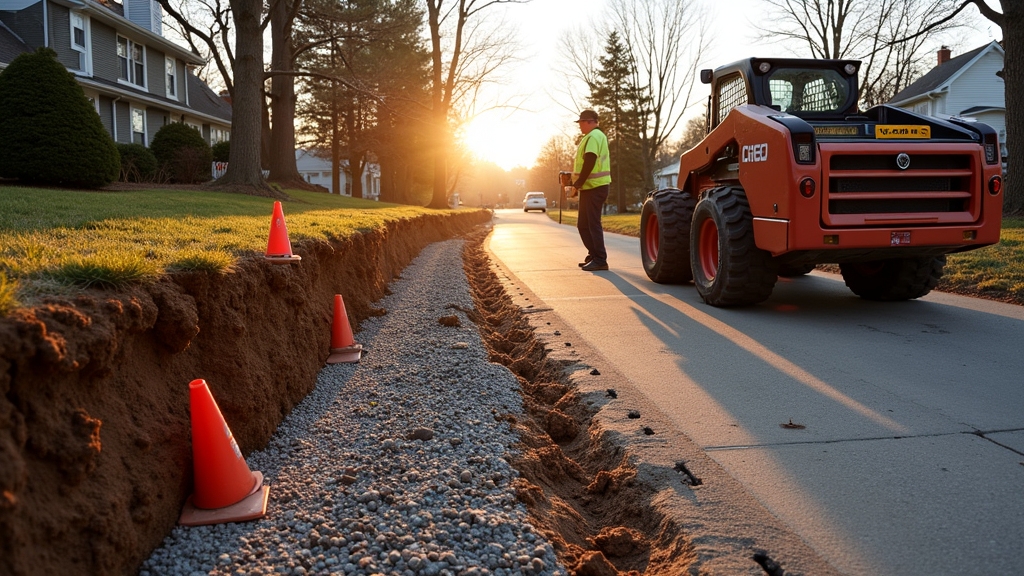
How well a contractor understands Bergen County’s soils, freeze–thaw cycles, drainage patterns, and municipal standards often predicts project outcomes.
Local expertise guides mix selection, base preparation, and thickness design that stand up to seasonal stress and steep grades. A reviewer should ask for nearby references and addresses, then observe surfaces for raveling, edge failure, birdbaths, and cracking patterns over multiple seasons.
A strong portfolio shows project diversity: driveways, HOA roads, commercial lots, and small municipal work.
Variety indicates skill with traffic loads, subgrade conditions, and phasing in tight neighborhoods. Photos should document before/after, sub-base depth, compaction steps, joint details, and changes to curbs or drains.
Longevity matters; projects performing well after three to five winters signal sound design and disciplined execution.
Demand Transparent Estimates and Detailed Proposals

Homeowners should request an itemized cost breakdown that clarifies labor, equipment, disposal, and contingencies.
They should verify the defined scope and timeline, including milestones, start dates, and completion targets.
Proposals should also specify materials and warranties, noting mix types, thicknesses, suppliers, and coverage terms.
Itemized Cost Breakdown
Although price is often the headline number, the real value lies in an itemized cost breakdown that shows exactly what is being paid for and why.
A trustworthy Bergen County paving company discloses cost factors and pricing strategies in clear line items so owners can compare proposals fairly and avoid surprises.
- Materials: asphalt mix type, additives, and tonnage, with unit prices that reflect market rates and haul distance.
- Labor: crew size, hourly rates, and anticipated hours, including supervision and safety compliance.
- Equipment: roller, paver, milling, and trucking charges, noting mobilization and minimums.
- Site preparation: excavation, base repair, drainage adjustments, and disposal fees, each priced separately.
A precise breakdown should also note contingencies, permit and testing fees, and applicable taxes.
Transparency builds confidence and supports apples-to-apples evaluations.
Scope and Timeline
With costs clearly itemized, the next priority is defining scope and timeline in writing. A reliable Bergen County contractor provides a clear sequence of work, from site preparation to final cleanup, with start and completion dates and a realistic project duration.
The proposal should specify task allocation: who handles permits, traffic control, drainage adjustments, grading, compaction, and striping. It should also detail daily work windows, contingency days for weather, and milestones tied to inspections.
Expect a site-access plan, staging areas for equipment, and a communication schedule identifying a single point of contact. Any dependencies—utility markings, neighbor notifications, or curb work—should appear upfront.
Change-order procedures must be written, stating how added work affects cost and time. Measurable deliverables and acceptance criteria reduce disputes.
Materials and Warranties
Before any contract is signed, materials and warranties should be spelled out in writing with the same rigor as scope and schedule. A reputable Bergen County contractor specifies asphalt types, mix designs, base aggregates, and binder grades, and ties each to performance expectations.
Clear documentation lets owners anticipate costs and understand warranty benefits tied to proper installation and maintenance.
- Identify asphalt types (e.g., dense-graded, polymer-modified) and lifts, with compaction targets and thickness tolerances.
- Require source certificates, batch tickets, and compliance with NJDOT or industry standards.
- Insist on written warranty terms: duration, covered defects, exclusions, transferability, and required maintenance.
- Demand a line-item estimate linking materials to unit prices, labor, and contingencies.
Transparent proposals reduce disputes and support long-term pavement value.
Assess Materials Quality and Equipment Capabilities
A critical step is verifying that a Bergen County asphalt contractor sources high-grade aggregates and uses performance-graded binders suitable for local freeze–thaw cycles and traffic loads.
Material durability depends on clean, well-graded stone, proper binder content, and additives such as polymers or anti-stripping agents tested to AASHTO or NJDOT standards. Reputable firms can provide mix design data, plant tickets, and compaction results that align with the project’s intended use, whether residential driveways or heavy truck routes.
Equipment types also signal capability. A professional crew deploys a calibrated paver with automatic grade and slope controls, vibratory steel-drum rollers sized to achieve target densities, and infrared thermometers to manage mat temperature.
Well-maintained milling machines, tack distributors, and plate compactors help guarantee smooth changes, uniform adhesion, and long service life.
Compare Warranties and Post-Project Support
Homeowners should compare warranty length and scope, noting coverage for materials, workmanship, and specific defects.
They should also confirm what is excluded and how claims are handled, including response times.
Post-project support matters too, such as scheduled maintenance, follow-up inspections, and availability for repairs.
Warranty Length and Scope
How long a warranty lasts—and what it actually covers—can separate reliable asphalt paving companies in Bergen County from the rest. A clear policy helps owners judge value beyond the bid price. Buyers should compare warranty types and warranty coverage with equal care, noting limits, exclusions, and claim procedures.
Strong contractors define responsibilities in writing and align terms with local climate stresses and traffic loads.
- Duration: Standard workmanship warranties range from one to five years; material warranties may extend longer through manufacturers.
- Scope: Look for coverage of cracking, raveling, ponding, and premature failure, not just cosmetic defects.
- Exclusions: Understand carve-outs for heavy loads, drainage changes, or de-icing chemicals.
- Claims: Require response timelines, documented inspections, and a defined remedy (repair, resurface, or replacement).
Maintenance and Follow-Up
Not all post-project support is equal, and maintenance commitments often reveal which asphalt paving companies in Bergen County stand behind their work.
Buyers should compare how each contractor structures follow-up visits, response times, and documented maintenance plans.
Strong providers outline a schedule for regular inspections during the first year and beyond, checking drainage, edges, and joints before minor issues spread.
They pair inspections with preventive measures such as timely crack sealing, sealcoating intervals, and spot patching to extend pavement life.
Clear contact channels and defined turnaround for service requests reduce downtime.
Evaluate how warranties integrate with maintenance: some require adherence to specified preventive measures to remain valid.
Seek itemized maintenance pricing, seasonal care guidance, and written reports after each inspection.
Check Reviews, References, and Red Flags
Why trust an asphalt contractor without proof of performance? A careful review process helps Bergen County property owners avoid costly mistakes.
Start with customer testimonials that describe outcomes, timelines, and service responsiveness. Then verify references and confirm project details match the claims. Balanced feedback across multiple platforms signals consistency, while patterns of complaints suggest deeper issues.
Start with detailed testimonials, verify references, and cross-check platforms—consistent feedback builds trust, complaint patterns reveal risk.
- Ask for three recent local references and call them; confirm schedule adherence, budget control, and cleanup quality.
- Read reviews on multiple sites; note specifics about communication, change orders, and warranty support.
- Watch for red flags: vague estimates, pressure to pay cash, no written contract, or no insurance proof.
- Compare photo galleries to references; inconsistent workmanship, recycled images, or stock photos indicate risk.
Frequently Asked Questions
How Long Will My Driveway Be Out of Service During Paving?
Typically, a driveway is out of service for 24–72 hours after paving.
Light foot traffic may resume within 6–12 hours, but vehicle access should wait until the asphalt cools and hardens.
Driveway downtime varies by weather, mix temperature, and thickness.
The paving process includes excavation, base preparation, compaction, laying hot mix, and rolling.
Cooler, dry conditions shorten cure times; hot or humid weather extends them.
Heavy vehicles should wait at least one week.
What Is the Best Season to Schedule Asphalt Paving in Bergen County?
The best season in Bergen County is typically late spring through early fall.
Spring paving offers moderate temperatures that help asphalt compact and cure reliably after winter frost.
Fall paving can be equally effective, benefiting from cooler nights that reduce rutting while still keeping daytime warmth for proper bonding.
Crews avoid extreme heat and cold, guarantee surface dryness, and monitor forecasted rain.
Scheduling during these windows supports stronger density, smoother finishes, and longer service life.
How Do Weather Delays Affect Project Timelines and Costs?
Weather delays extend timelines by halting crews, disrupting project scheduling, and forcing resequencing of tasks.
Weather impacts include moisture intrusion, temperature drops, and drying-time setbacks, which can require rework or material disposal.
Costs rise from idle labor, equipment standby, mobilization repeats, and potential asphalt mix price adjustments.
Contractors mitigate risks with buffer days, seasonal planning, and flexible crews, but sustained adverse conditions still compress float, shift milestones, and increase contingency drawdowns and change-order likelihood.
Can You Coordinate Permits and Utility Mark-Outs on My Behalf?
Yes. The provider can handle permit coordination and arrange utility marking on the client’s behalf.
They typically submit applications to the local municipality, track approvals, and schedule inspections. For utility marking, they contact the state One Call center to locate and mark underground lines before excavation.
They also align permit timelines with project scheduling, communicate any agency requirements, and provide documentation so the client remains informed while minimizing delays, compliance risks, and administrative burden.
What Maintenance Steps Should I Follow After the First 30 Days?
After the first 30 days, they should begin routine driveway cleaning, removing debris, leaves, and oils with a gentle detergent and soft broom.
They should avoid harsh chemicals and metal shovels.
Schedule asphalt sealing after 6–12 months, then every 2–3 years, ensuring the surface is fully dry and temperatures are moderate.
Fill small cracks promptly with compatible filler.
Prevent standing water by maintaining drainage, and keep heavy, stationary loads off the same spots to reduce rutting.
Final Thoughts
The best Bergen County paving partners make it easy to choose them: they prove licensing and insurance, follow OSHA/DEP rules, know local soils and freeze–thaw behavior, and provide transparent, itemized proposals with NJDOT-compliant mixes, specified lifts and thicknesses, realistic timelines, and written warranties. They back claims with nearby references that have survived multiple winters, use calibrated equipment, and offer maintenance plans with clear pricing. If a bid is vague or unusually low, treat it as a red flag. When you compare apples to apples—scope, materials, compaction targets, drainage, schedules, cleanup, and warranty terms—the right choice stands out on value and durability.
Want a spec-driven, line-item proposal from a local team? Meet Parkway Paving LLC. We deliver asphalt driveway paving, residential asphalt paving, commercial & parking lot paving, plus asphalt resurfacing and sealcoating tailored to Bergen County conditions.
Get a clear, comparable bid today—contact Parkway Paving LLC or call (862) 596-0642 to schedule your on-site assessment. We’ll specify it right, price it transparently, and pave it to last.