
Your asphalt needs professional repair when you notice alligator cracking, standing water, fading from black to gray, forming potholes, spreading hairline cracks, persistent oil stains, sunken areas, raveling with loose aggregate, shrinking joints near concrete borders, or edge deterioration. These warning signs indicate compromised structural integrity that worsens without intervention. Early detection can prevent extensive damage and save you thousands in complete replacement costs.
Key Takeaways
- Alligator cracking patterns indicate subsurface structural failure and require professional assessment for patching or complete reconstruction.
- Standing water and pooling reveal critical drainage problems that accelerate asphalt breakdown and need immediate professional attention.
- Edge deterioration with crumbling material signals compromised load-bearing capacity, especially dangerous with continued heavy vehicle traffic.
- Widening gaps between asphalt and concrete borders indicate joint failure that allows water infiltration and progressive damage.
- Fading from black to gray shows UV damage and oxidation that makes asphalt brittle, requiring professional sealcoating to prevent further deterioration.
Alligator Cracking Appearing Across Surfaces
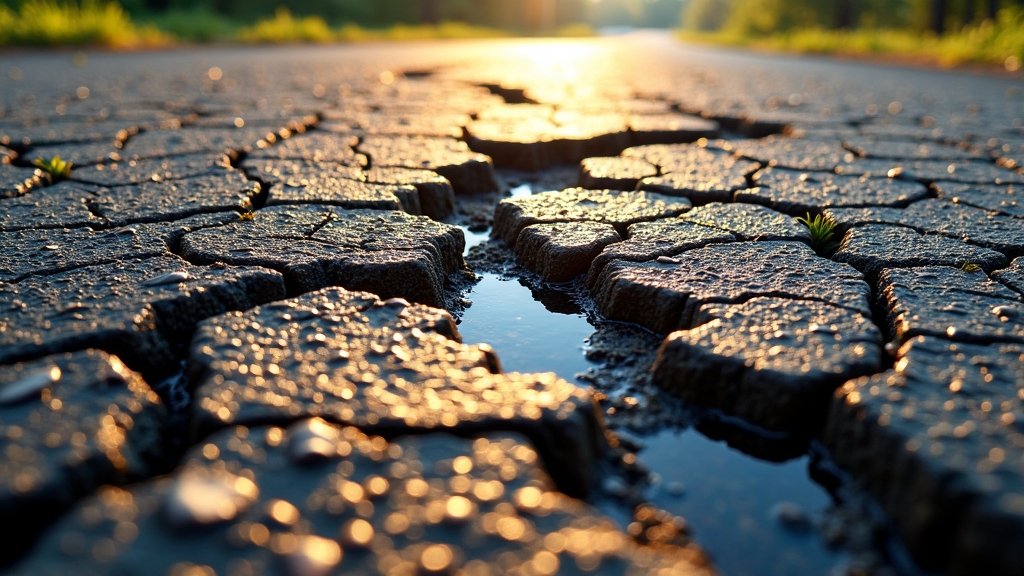
Alligator cracking, characterized by its distinctive interconnected fracture pattern resembling reptilian scales, represents one of the most definitive indicators of subsurface structural failure in asphalt pavements.
When you notice these networks of cracks forming on your pavement, you’re witnessing the consequences of foundation weakness or moisture infiltration beneath the surface.
The primary alligator cracking causes include inadequate base support, excessive loading beyond design capacity, and water penetration that weakens the subgrade materials.
You’ll typically observe these patterns first in high-traffic areas or where drainage is compromised.
Don’t delay implementing alligator cracking solutions once identified.
Professional contractors will assess whether partial patching suffices or if full-depth reconstruction is necessary. They’ll address the underlying drainage issues, strengthen the base materials, and apply proper compaction techniques.
Without intervention, these fractures will accelerate deterioration, leading to potholes and considerably more expensive repairs.
Standing Water and Drainage Issues
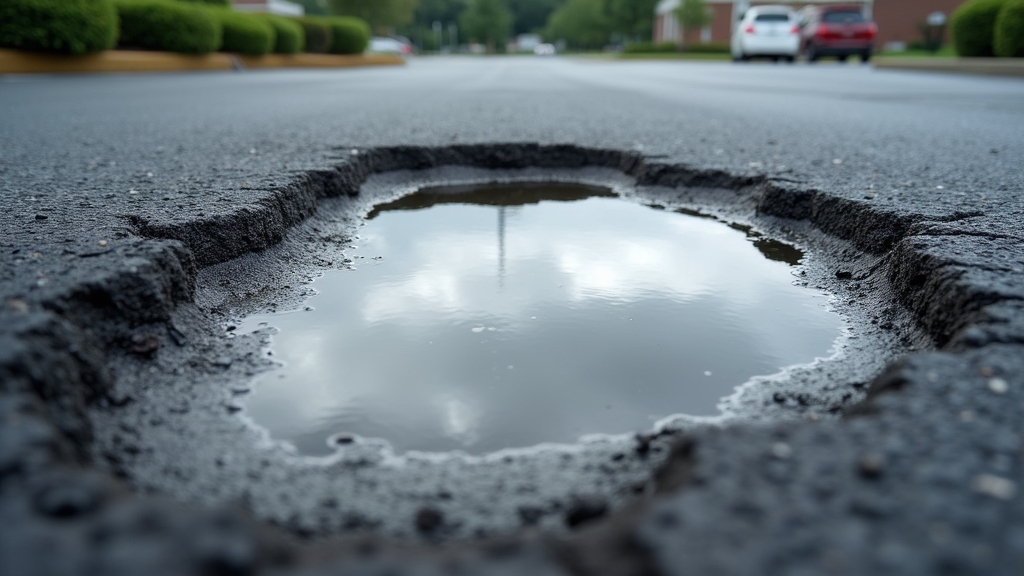
Standing water on your asphalt surface represents a critical indicator of underlying structural problems requiring immediate attention.
You’ll notice water pooling in depressions after rainfall, creating uneven flow patterns that fail to direct moisture away from the paved area.
The presence of soggy, soft areas around the perimeter often signals compromised drainage systems that accelerate pavement deterioration through water infiltration and subsequent foundation weakening.
Pooling After Rainfall
When rainwater fails to properly drain from your asphalt surface, it creates localized pooling that signals underlying structural deficiencies. These water accumulations aren’t merely inconvenient—they’re active contributors to pavement deterioration. The pooling causes accelerated breakdown of asphalt binders and weakens the subbase through infiltration.
| Pool Characteristics | Probable Causes | Drainage Solutions |
| Shallow, wide areas | Surface depression | Infrared patching |
| Deep, confined pools | Structural failure | Full-depth repair |
| Linear patterns | Failed expansion joints | Joint sealing |
| Edge accumulation | Improper grading | Perimeter drains |
| Intermittent spots | Deteriorated base material | Base reconstruction |
You’ll need to address these issues promptly with appropriate drainage solutions before they expand into costlier repairs. Professional contractors can implement proper slope correction, install drainage channels, or perform targeted repairs to restore proper water evacuation.
Uneven Water Flow
Drainage patterns across asphalt surfaces reveal critical information about subsurface integrity and overall pavement health. When you observe water flowing in irregular patterns or collecting in unintended areas, you’re witnessing symptoms of structural compromise.
These abnormalities often indicate depressions, settling, or improper initial grading that disrupts designed water runoff pathways.
Monitor how precipitation travels across your pavement during rainfall. Ideally, water should move uniformly toward designated drainage points. Irregular channeling suggests base layer failure or surface deterioration requiring professional assessment.
Left unaddressed, these issues accelerate pavement breakdown through freeze-thaw cycling and continuous erosion.
Effective drainage solutions may include surface regrading, installation of additional drainage channels, or thorough resurfacing with proper pitch restoration.
Acting promptly when you detect uneven water flow prevents more costly structural repairs later.
Soggy Perimeter Areas
Perimeter saturation along asphalt edges often signals critical subsurface drainage failures requiring immediate attention.
You’ll notice this phenomenon when soil surrounding your pavement remains persistently damp even during dry weather periods. This soggy soil condition indicates water isn’t properly channeling away from your asphalt structure.
When inspecting your property, pay particular attention to discoloration or algae growth along pavement boundaries. These visual indicators reveal chronic moisture exposure.
Additionally, if you observe your asphalt’s edges beginning to crumble or sink, drainage concerns have likely progressed to structural compromise.
Left unaddressed, perimeter saturation will undermine your pavement’s foundation, creating voids beneath the surface that eventually trigger widespread cracking and deformation.
Professional assessment can identify compromised drainage systems before catastrophic failure occurs, potentially saving you significant replacement costs.
Fading Color and Gray Appearance
When your asphalt surface begins shifting from deep black to a grayish hue, you’re witnessing UV radiation breaking down the binding agents in the pavement.
This oxidation process occurs as ultraviolet light degrades the petroleum-based components, causing the asphalt to lose its protective oils and become increasingly brittle.
You should monitor color changes carefully, as this fading represents not merely an aesthetic concern but a critical indicator that your pavement requires sealcoating to prevent more severe structural deterioration.
UV Damage Indicators
Ultraviolet radiation from the sun progressively degrades the binding agents in asphalt pavement, manifesting initially as noticeable color changes.
This ultraviolet degradation accelerates the oxidation process, causing your pavement to lose its flexibility and develop surface brittleness over time.
You’ll recognize advanced UV damage through these specific indicators:
- Pronounced graying in previously jet-black sections
- Fine powder residue appearing on the surface when rubbed
- Micro-cracking patterns forming in a distinctive “alligator skin” arrangement
- Increased surface temperature absorption compared to newer asphalt
These signs indicate that UV exposure has compromised your pavement’s protective components.
Without intervention, the affected areas will continue deteriorating, leading to structural weakness and eventual failure.
Professional sealcoating applied every 2-3 years provides essential UV protection and extends pavement lifespan considerably.
Oxidation Process Explained
Although often mistaken for simple cosmetic deterioration, the oxidation process in asphalt pavement represents a complex chemical transformation that threatens structural integrity.
When your asphalt transforms from deep black to a faded gray, you’re witnessing oxidation effects—the reaction between asphalt’s hydrocarbon molecules and atmospheric oxygen.
This chemical process gradually breaks down the binding properties of bitumen, causing the pavement to become increasingly brittle and vulnerable to cracking.
You’ll notice surface aggregate becoming more visible as the binding materials deteriorate.
Every exposure to oxygen, UV radiation, and temperature fluctuation accelerates this natural aging mechanism.
Without intervention, oxidation greatly reduces asphalt lifespan by diminishing flexibility and resistance to weight loads.
Implementing sealcoating every 2-3 years creates a protective barrier that dramatically slows this deterioration process.
Potholes Beginning to Form
Before fully developed potholes disrupt your pavement’s integrity, several warning indicators emerge that demand immediate attention. These preliminary signs manifest as small depressions, often accompanied by hairline cracks that form interconnected networks. Understanding these early stages is vital for implementing effective pothole prevention strategies before structural deterioration advances.
When inspecting your asphalt, watch for:
- Alligator cracking – Interconnected cracks resembling reptile scales, indicating subsurface weakness.
- Sunken areas – Subtle depressions where water pools, accelerating deterioration through freeze-thaw cycles.
- Aggregate exposure – Asphalt binder erosion revealing stone material underneath.
- Edge crumbling – Degradation along pavement boundaries signaling structural compromise.
These indicators necessitate prompt intervention with appropriate repair techniques such as infrared patching or saw-cutting.
You’ll achieve best results by addressing these warning signs during moderate temperatures, as extreme conditions compromise adhesion quality and longevity of repairs.
Multiple Hairline Cracks Spreading
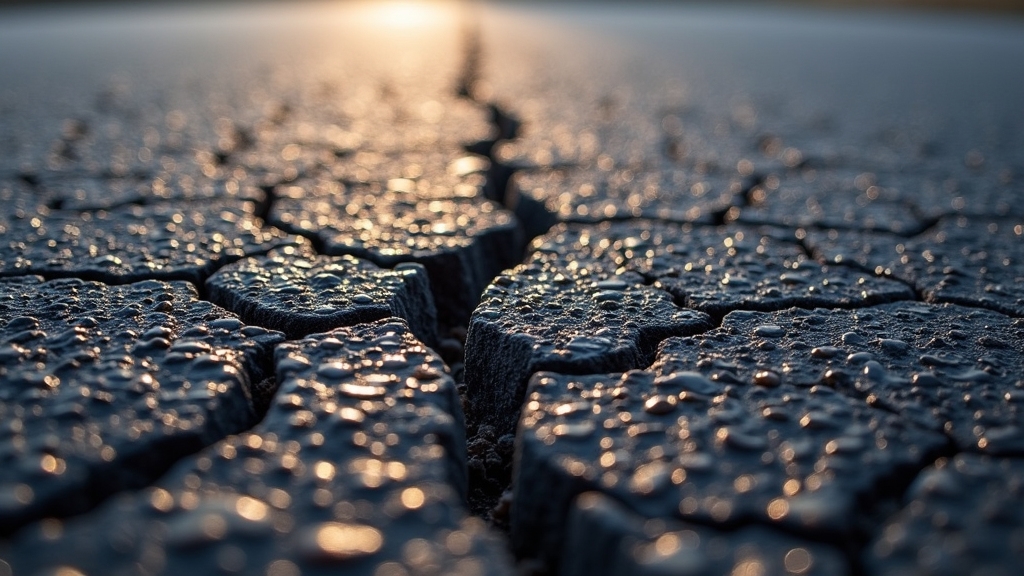
While seemingly innocuous at first glance, hairline cracks represent a critical juncture in asphalt deterioration that you can’t afford to ignore. These thin fissures typically measure less than 1/8 inch wide but signal compromised surface integrity throughout your pavement structure.
Don’t mistake hairline cracks for minor imperfections—they’re early warning signals of serious pavement breakdown requiring immediate attention.
When you observe these cracks multiplying or forming interconnected patterns—often resembling spider webs or alligator skin—you’re witnessing active deterioration. Water infiltration through these openings accelerates damage by undermining the base layers, especially during freeze-thaw cycles. The expansion of trapped moisture widens existing hairline cracks exponentially.
You’ll identify this warning sign when multiple cracks appear across substantial sections rather than isolated areas. The affected asphalt will often retain its level profile initially, distinguishing these from more advanced failures.
Professional intervention at this stage—typically through crack sealing or surface treatments—prevents progression to costlier rehabilitation. Delaying repairs once hairline cracks begin spreading virtually guarantees more extensive reconstruction requirements within 12-24 months.
Edges Breaking and Crumbling
Edges breaking and crumbling along your asphalt pavement indicate moisture has penetrated the structure, compromising its load-bearing capacity as water weakens the binding materials.
You’ll notice this deterioration accelerates when heavy vehicles travel near the pavement’s perimeter, causing further displacement of the weakened materials.
Proper drainage implementation becomes critical at this stage, as redirecting water flow away from vulnerable edges prevents additional erosion and extends the functional lifespan of your asphalt surface.
Moisture Invasion Effects
When moisture penetrates the boundaries of asphalt pavement, it initiates a destructive process that manifests as breaking and crumbling edges.
You’ll notice deterioration accelerates during freeze-thaw cycles as water expands within microscopic fissures, forcing apart the aggregate structure. Proper moisture barriers become compromised, leading to progressive failure of the pavement’s structural integrity.
Water absorption occurs through four distinct mechanisms:
- Capillary action drawing moisture beneath the asphalt surface
- Hydrostatic pressure forcing water upward from subsurface layers
- Infiltration through existing cracks and joints
- Edge penetration where asphalt interfaces with soil or other materials
This moisture intrusion weakens the binding properties between asphalt and aggregate, creating zones of instability.
Without intervention, you’ll experience accelerated deterioration requiring more extensive and costly repairs than preventive maintenance would have necessitated.
Load-Bearing Capacity Compromised
As asphalt pavement deteriorates, its structural integrity diminishes considerably, leading to compromised load-bearing capacity along vulnerable edge areas.
You’ll notice edges breaking and crumbling when the pavement can no longer properly distribute vehicle weight across its surface.
This degradation occurs when the base materials beneath your asphalt weaken, causing stress concentration at the perimeter.
Watch for crumbled material along driveway borders or parking lot edges—these aren’t merely cosmetic issues but indicators of structural failure.
When you observe vehicles exceeding weight limits regularly traversing your pavement, you’re accelerating this deterioration.
Heavy trucks or equipment create excessive downward pressure that fragmented edges can’t withstand.
Professional repair becomes necessary once you identify these symptoms, as continued use will only expand the damaged area exponentially.
Proper Drainage Issues
Poor drainage conditions often accompany edge deterioration and represent a primary catalyst for asphalt failure.
When water accumulates along pavement edges, it infiltrates the base materials, compromising structural integrity. You’ll notice the edges breaking and crumbling as moisture undermines the asphalt’s foundation.
Effective water management requires identifying drainage issues early:
- Puddles remaining 24+ hours after rainfall indicate improper surface grading
- Vegetation growing along pavement edges signals persistent moisture presence
- Discoloration patterns extending from edges inward reveal water penetration paths
- Sediment deposits on pavement surfaces demonstrate water flow problems
Implementing proper drainage solutions before extensive damage occurs saves significant repair costs.
Consider installing channel drains, adjusting the pavement’s slope, or creating runoff pathways to divert water away from vulnerable asphalt edges.
Oil Stains That Won’t Wash Away
Persistent oil stains on your asphalt pavement represent a significant warning sign of potential structural deterioration. Unlike temporary surface discoloration, stubborn oil marks indicate petroleum-based substances have penetrated beyond the asphalt’s protective sealcoat, attacking the binding agents that maintain structural integrity.
When standard asphalt cleaning methods fail to remove these stains, you’re facing more than an aesthetic issue. The oil has likely already begun softening the asphalt matrix, creating vulnerable areas prone to cracking and pothole formation.
Professional oil stain removal becomes essential at this stage, as commercial-grade solvents and pressure washing techniques can extract contaminants before they cause irreversible damage.
Monitor areas where vehicles regularly park or where mechanical equipment operates. If you notice darkened spots that remain after rainfall or washing attempts, consider this an urgent indicator that your pavement requires professional assessment to prevent accelerated deterioration and more costly repairs later.
Sunken Areas and Depressions
Depressions and sunken spots across your asphalt surface indicate serious underlying structural problems that require immediate attention.
These pavement failures typically result from compromised base layers or inadequate drainage, causing sections to settle unevenly. Driveway settlement often begins as minor depressions that gradually worsen, creating dangerous tripping hazards and water collection points that accelerate deterioration.
Four primary causes of sunken pavement include:
- Subgrade failure – The soil beneath your asphalt has compressed or eroded.
- Poor initial compaction – Inadequate base preparation during installation.
- Water infiltration – Moisture penetrating and weakening the foundation layers.
- Heavy vehicle pressure – Consistent weight stress exceeding pavement capacity.
You’ll need to address these depressions promptly before they expand.
Professional contractors will assess the extent of base failure, remove affected sections, reestablish proper grading, and install new asphalt to restore structural integrity.
Delaying repairs typically leads to complete pavement failure requiring full reconstruction.
Raveling and Loose Aggregate
Surface deterioration known as raveling occurs when individual aggregate particles separate from the asphalt binder and become dislodged across your pavement. This progressive degradation typically begins with fine particles breaking away, then gradually affects larger aggregate components.
Primary raveling causes include oxidation of the binding material, poor initial compaction during installation, inadequate mix design, or excessive water penetration.
Pavement raveling often stems from binder oxidation, insufficient compaction, poor mix formulation, or moisture intrusion weakening the asphalt structure.
You’ll notice raveling when your asphalt surface appears increasingly rough and coarse, with visible loose stones accumulating along pavement edges and drainage areas. If left untreated, this condition accelerates, creating safety hazards from displaced materials and compromising structural integrity.
Effective loose aggregate solutions depend on severity. For early-stage raveling, seal coating provides a protective layer that rebinds surface particles.
Advanced cases require more substantial interventions such as overlay applications or complete replacement of the affected sections to restore proper pavement integrity and functionality.
Shrinking Joints Around Concrete Borders
While raveling affects the asphalt surface itself, another telling indicator of pavement deterioration appears at boundary interfaces. When you notice widening gaps between your asphalt and concrete borders, you’re witnessing joint displacement, a condition that signals underlying structural issues requiring immediate attention.
These shrinking joints manifest through several observable changes:
- Visible separation exceeding ¼ inch between asphalt edges and concrete curbing
- Crumbling asphalt material along the concrete-asphalt interface
- Water pooling or vegetation growth within widened boundary areas
- Loss of concrete adhesion evidenced by height discrepancies between surfaces
The technical explanation involves thermal cycling and moisture infiltration. As temperature fluctuates, asphalt expands and contracts at different rates than adjacent concrete structures.
Without proper joint sealant maintenance, water penetrates these gaps, accelerating deterioration through freeze-thaw cycles. This undermines structural integrity by compromising the load-bearing capacity where materials meet, potentially leading to progressive pavement failure if left unaddressed.
Frequently Asked Questions
How Long Does Professional Asphalt Repair Typically Last?
Your asphalt repair’s lifespan depends on repair techniques used. Properly executed professional repairs typically last 8-15 years, with high-quality sealcoating extending longevity. Variables include climate, traffic volume, and initial installation quality.
What’s the Average Cost of Asphalt Repair Versus Full Replacement?
You’ll spend $1-4 per square foot for asphalt repairs compared to $3-7 for full replacement. Cost comparison depends on repair methods used, existing damage extent, and surface area requiring treatment.
Can I Repair My Asphalt Driveway in Winter Months?
You shouldn’t repair asphalt during winter months. Cold temperatures prevent proper material bonding and curing. Winter asphalt repairs are typically temporary at best, with seasonal considerations favoring spring through fall for effective, lasting results.
How Soon Can I Drive on Newly Repaired Asphalt?
You shouldn’t drive on newly repaired asphalt for 24-72 hours. The asphalt curing process requires this time to properly set. Driving restrictions vary based on temperature, repair type, and asphalt thickness. Follow contractor recommendations precisely.
Are There Environmentally-Friendly Options for Asphalt Repair Materials?
Yes, you can choose sustainable materials like recycled asphalt, bio-based binders, and permeable options. These eco-friendly techniques reduce environmental impact while maintaining performance. Contractors increasingly offer these alternatives to conventional petroleum-based repair solutions.
Final Thoughts
When you spot early warning signs—alligator cracking, standing water, spreading hairline cracks, edge crumble, sinking areas, or stubborn oil stains—don’t wait. Prompt, professional repair prevents moisture intrusion, restores load-bearing strength, and can spare you from costlier overlays or full-depth replacement. Follow a simple playbook: assess drainage, prioritize structural fixes, then protect the surface with sealcoating and routine inspections.
For a fast, accurate diagnosis and the right fix—whether targeted patching, resurfacing, or full asphalt driveway paving—partner with the local experts at Parkway Paving LLC.
Get ahead of the damage today—contact Parkway Paving LLC or call (862) 596-0642 to schedule your professional assessment. We’ll pinpoint the cause, recommend the most cost-effective repair, and keep your pavement performing for years.